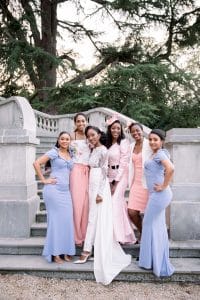
The bouquet is in your hands for some of the most photographed moments of your wedding day. You will carry it down the aisle, hold it during your ceremony and pose with it throughout the day.
It is also one of the most personal floral choices you will make.
For an international couple getting married in France, choosing a wedding bouquet can feel slightly different from planning flowers at home. The season, local availability and French floral traditions can all influence what your florist can create.
You may already have a flower in mind. Perhaps you have always dreamed of peonies, lilies or lily of the valley. But what happens if your favorite flower is not naturally available when you get married?
This does not mean you need to abandon your vision.
We recommend starting with the feeling you want rather than a fixed list of flowers. Think about your colors, your dress, your venue and the atmosphere you want to create. Then let your florist translate that vision into flowers that are beautiful and available at the right time of year.
Start with your wedding style, not the flowers
Before choosing individual flowers, look at your wedding as a whole.
Your bouquet should feel connected to the rest of the celebration. It does not need to match every floral arrangement, but it should belong to the same visual story.
Think about :
- Your wedding venue
- Your dress
- The season
- The time of day
- Your wedding colors
- The ceremony setting
- The level of formality
- Your personal style
A loose, organic bouquet can feel wonderful at a countryside wedding. A more structured bouquet may suit a formal Parisian celebration.
The proportions matter too.
A generous bouquet can create a beautiful statement with a simple wedding dress. A petite bouquet may work better with an elaborate gown or a very intimate ceremony.
If you are planning a destination wedding, the location should also influence your choices. Our guide to planning a destination wedding in France can help you think about how the setting influences the overall experience.
The bouquet should feel like part of your wedding, not like an accessory chosen separately.
Choose flowers that mean something to you
Flowers have carried symbolic meanings for centuries.
These meanings can vary between cultures, so we would not treat them as strict rules. Still, they can add a beautiful layer of meaning to your bouquet.
For example :
| Flower | Traditional meaning | Style |
| Rose | Love and romance | Timeless and versatile |
| Peony | Happiness and prosperity | Soft and generous |
| Lily of the valley | Happiness and renewal | Delicate and romantic |
| Lily | Purity and devotion | Elegant and refined |
| Hydrangea | Gratitude and heartfelt emotion | Full and abundant |
| Anemone | Protection and anticipation | Graphic and delicate |
| Sweet pea | Bliss and gratitude | Light and romantic |
Lily of the valley has a particularly strong connection with spring in France. Its delicate bell shaped flowers can create a very refined bouquet, especially for an intimate wedding.
Lilies can bring a completely different feeling. Their shape gives a bouquet more presence, while their traditional association with purity makes them a meaningful choice for a wedding.
You can also choose flowers for personal reasons rather than their traditional symbolism.
Perhaps roses remind you of your grandmother’s garden. Maybe you met in a place filled with hydrangeas. Or perhaps you simply love the way a particular flower looks.
That personal connection matters more than any flower dictionary.
For international couples, this can also be a lovely way to combine cultures. You might choose flowers that have meaning in your home country and combine them with seasonal French flowers.
Think about the season before falling in love with a flower

This is one of the most important things to understand when planning flowers for a wedding in France.
A flower that is everywhere in one season may be difficult to source at another time. Availability can also vary according to the region and the weather.
This is why we recommend giving your florist a mood and a palette rather than insisting on a precise list of flowers.
Here are some examples of flowers associated with different seasons in France :
| Season | Flowers to consider | What they bring |
| Spring | Peonies, tulips, ranunculus, lily of the valley | Fresh, delicate and romantic |
| Summer | Roses, dahlias, hydrangeas, lisianthus | Abundant and colorful |
| Autumn | Dahlias, roses, chrysanthemums, berries | Warm and rich |
| Winter | Anemones, ranunculus, orchids, hellebores | Elegant and structured |
Spring offers some of the most romantic possibilities. Peonies are a favorite for many brides, while lily of the valley brings something much more delicate.
Summer requires a little more thought, particularly for weddings in July and August. High temperatures can affect delicate flowers, especially if your ceremony takes place outdoors.
If you are planning a summer celebration, our guide to choosing your wedding look for a summer wedding also explores how the heat can influence other choices during the day.
Autumn opens the door to richer colors and generous textures. Dahlias can create spectacular bouquets, while warm foliage and berries can add depth.
Winter does not mean boring flowers. Anemones, hellebores and orchids can create a sophisticated and very elegant bouquet.
The season is not a limitation. It is part of the creative brief.
Read our Best time to get married in Paris guide to learn more about.
Choose the shape and size of your bridal bouquet
The shape of your bouquet can change the entire impression of your wedding look.
A round bouquet feels classic and polished. A loose bouquet feels more natural and effortless. A cascading design creates movement and can feel particularly dramatic.
Some common styles include :
- Round bouquets
- Loose organic bouquets
- Cascading bouquets
- Petite bouquets
- Asymmetrical bouquets
- Hand tied bouquets
Your dress should influence the decision.
A very structured gown can work beautifully with an equally refined bouquet. A flowing dress may feel more natural with an organic arrangement.
Your height and proportions also matter.
A very small bouquet can disappear next to a voluminous dress. A very large bouquet can overwhelm a petite silhouette.
Your venue matters too.
A grand Parisian setting can support a more dramatic bouquet. A small garden ceremony may call for something lighter and more natural.
There is no universal rule. The right size is the one that feels balanced with your entire look.
Match your bouquet with your wedding colors

Your bouquet does not need to reproduce your wedding color palette flower by flower.
In fact, we often prefer a little variation.
You can use your bouquet to :
- Repeat one of your main colors
- Introduce a softer shade
- Add a contrasting color
- Create a monochromatic look
- Bring in natural greenery
- Introduce a small unexpected detail
For example, a neutral wedding can benefit from a bouquet with soft blush tones. A colorful summer wedding can embrace several shades without looking chaotic.
Your bouquet can also connect different parts of the day.
A flower used in your bouquet could appear again in the ceremony arrangements or on the dinner tables. This creates continuity without making everything identical.
If you are still defining your palette, you can also explore current wedding color trends for inspiration.
The goal is not perfect matching. It is visual harmony.
Think about the practical side of your wedding bouquet
Your bouquet needs to survive more than a beautiful ceremony.
It may be with you for several hours. You may carry it outside, pose for photographs, move between locations and hold it during the reception.
This matters even more for destination weddings.
Think about :
- The expected temperature
- How long you will be outside
- Whether the ceremony is indoors or outdoors
- How far you will travel with the bouquet
- The weight of the arrangement
- The fragility of the flowers
- How the bouquet will be stored before the ceremony
Heat deserves particular attention in July and August.
Some flowers are more sensitive to high temperatures than others. Your florist can suggest alternatives that create the same visual effect while handling the conditions better.
This is one reason why working with a florist who knows the local climate and seasonal flowers can make the process easier.
You should also think about the weight.
A bouquet can look beautiful in a photograph but feel surprisingly heavy after holding it for twenty minutes.
Your florist should know how to balance beauty and comfort.
After all, you will be carrying it while walking, standing, hugging your guests and posing for photographs.
Let your florist create something that feels natural

One of the easiest mistakes is to approach your florist with a photograph and ask for exactly the same bouquet.
Inspiration photographs are useful. They show your florist what you like about a particular design.
But they should be a starting point.
Instead of saying, “I want exactly these flowers”, explain :
- The colors you love
- The colors you dislike
- The atmosphere you want
- The shape you prefer
- Flowers that have personal meaning
- Your dress style
- Your venue
- Your wedding date
- Your approximate budget
A wedding bouquet in France can vary widely in price depending on its size, flowers and level of design. As a broad starting point, many bridal bouquets fall somewhere around €150 to €300, while larger or highly bespoke arrangements can go beyond €400.
Your florist can then work with the flowers that are naturally available at your wedding date.
This can lead to something even more beautiful than your original inspiration.
You are not asking the florist to reproduce a photograph. You are giving them the ingredients for your wedding story.
Wedding bouquet checklist
Before finalizing your bouquet, make sure you have considered :
- Your wedding style
- Your dress
- Your wedding colors
- The season in France
- Flower availability
- Flower symbolism
- Bouquet shape
- Bouquet size
- Expected temperature
- Your budget
- The practical weight of the bouquet
- The experience and style of your florist
For international couples, we would also recommend sharing photographs of your dress and venue with your florist as early as possible.
The more context they have, the better they can understand the overall picture.
FAQ – Wedding bouquet
How do I choose the right wedding bouquet?
Start with your dress, wedding style, venue and season. Then choose a shape, color palette and flowers that reflect your personality.
What flowers are best for a wedding bouquet?
There is no single best flower. Roses, peonies, dahlias, lilies, anemones, hydrangeas and lily of the valley can all create beautiful bouquets, depending on the season and style.
What flowers are in season for a French wedding?
Spring can offer peonies, tulips, ranunculus and lily of the valley. Summer brings roses, dahlias and hydrangeas. Autumn offers dahlias, roses and richer textures. Winter can feature anemones, hellebores and orchids.
What does lily of the valley symbolize in a wedding bouquet?
Lily of the valley is traditionally associated with happiness, renewal and good fortune. Its delicate appearance also makes it a beautiful choice for spring weddings.
What do lilies symbolize in a wedding?
Lilies are often associated with purity and devotion. Their elegant shape can also bring a more refined and structured feeling to a bridal bouquet.
Should the bridal bouquet match the wedding decorations?
Not exactly. Your bouquet should feel connected to the overall floral design, but it does not need to reproduce the centerpieces or ceremony flowers.
How much does a wedding bouquet cost in France?
A bridal bouquet can start around €150 and increase beyond €400 for larger or highly bespoke designs. The flowers, season, size and florist all influence the final price.
What flowers should I choose for a summer wedding in France?
Choose flowers that can handle the expected conditions, particularly if your ceremony takes place outdoors. Your florist can suggest seasonal alternatives that are more resistant to heat.