The white dress, the wedding rings, the bouquet, the cake, the first dance… Some wedding traditions feel so familiar that we rarely stop to ask where they came from.
Yet behind many of them lies a story.
Some traditions were once linked to religion, family alliances, fertility or good fortune. Others changed meaning over time. Some have almost disappeared, while others have crossed borders and become part of weddings all over the world.
Today, couples also have more freedom to choose what belongs in their wedding. A tradition can be kept exactly as it is. It can be adapted to your culture. Or you can leave it behind.
For couples coming to France for a destination wedding, this freedom can be particularly interesting. You do not have to choose between your own traditions and the French way of celebrating. You can bring both together and create something that feels natural to you.
Why do we have wedding traditions?
Wedding traditions are often much older than the weddings we know today.
In ancient civilizations, marriage was not only about romantic love. It could also connect families, create alliances and reinforce social relationships. Rings, gifts, celebrations and symbolic rituals were already part of marriage ceremonies in ancient Egypt, Greece and Rome.
Religion then shaped many wedding customs across different cultures. Christian, Jewish, Hindu and other religious traditions developed their own ceremonies and symbols.
Over time, many of these rituals became cultural rather than strictly religious.
That is why a couple can exchange rings, wear white or cut a wedding cake without necessarily thinking about the original meaning behind these gestures.
Traditions also travel.
American wedding customs have become familiar in Europe through films, television and international weddings. French couples may now have a first look or bridesmaids, while American couples getting married in France may fall in love with a French croquembouche.
This is what makes wedding traditions so interesting. They are not frozen in time.
They evolve with us.
French wedding traditions worth knowing
If you are planning a destination wedding in France, some French customs may feel familiar, while others may be completely new.
The wedding bouquet
The bouquet is one of the most recognizable wedding traditions in France.
The bride carries flowers during the ceremony and may later toss the bouquet to her guests. The person who catches it is traditionally said to be the next to marry.
Of course, you do not have to organize a bouquet toss.
For an intimate wedding or elopement, we often prefer to keep the flowers as part of the couple’s story. The bouquet can then become part of the photographs or be taken back to the hotel.

The white wedding dress
The white dress has become one of the strongest symbols of the Western wedding.
Its popularity increased significantly in the 19th century, particularly after Queen Victoria’s wedding. Today, white can represent elegance, celebration and a new chapter rather than simply purity.
And there is no rule saying your wedding dress has to be white.
A civil ceremony in Paris can look just as beautiful with an ivory dress, a modern suit or something more fashion forward.

Wedding rings
Rings represent unity and continuity.
Their history goes back much further than modern Western weddings. Ancient Egyptians and Romans already used rings as symbols of commitment.
Today, the ring exchange remains one of the easiest traditions to personalize.
You can exchange classic wedding bands. You can add personal vows. You can also include a family ring or another meaningful object.

The French wedding dessert
If you are getting married in France, dessert is another opportunity to embrace a local tradition.
The pièce montée, often associated with the French wedding celebration, traditionally takes the form of a croquembouche made with cream filled choux pastries and caramel. It is both a dessert and a visual centerpiece.
Food is also part of the story. A French wedding does not necessarily revolve around the classic tiered wedding cake. Couples may choose a croquembouche, a refined pastry creation, or another dessert that reflects French culinary traditions. If you are curious about the options, we have gathered some ideas in our guide to choosing your French wedding cake. It is a lovely way to bring a distinctly French touch to your celebration without giving up your own preferences.
For an American couple, it can be a lovely way to bring a distinctly French touch to the reception without changing the rest of the wedding.
Wedding traditions around the world
There is no single definition of a traditional wedding.
Every culture has its own rituals, symbols and expectations. Some are religious. Others are family traditions passed from one generation to another.
American wedding traditions
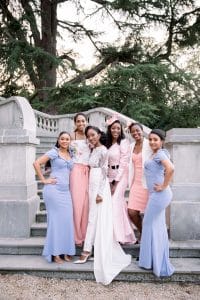
Bridal parties are another good example of how wedding customs can vary from one country to another. American couples often have a group of bridesmaids and groomsmen with defined roles throughout the wedding. In France, the tradition is less formal, especially for intimate celebrations. If you are bringing American wedding customs into a French destination wedding, it can be helpful to decide what you actually expect from your bridal party. Our guide on how to choose your bridesmaids and define their role explores the practical and personal side of that decision.
The role of the bridesmaid can be particularly important. She may be a sister, a lifelong friend or another person who has played a meaningful role in the bride’s life.
Many American couples also choose personal vows and a ceremony that reflects their relationship rather than following a fixed religious structure.
Jewish wedding traditions
Jewish weddings include several distinctive rituals.
The chuppah represents the couple’s future home. The signing of the ketubah and other elements give the ceremony a strong cultural and religious identity.
Some couples incorporate Jewish traditions into a wedding in France while also creating a ceremony that reflects their own family history.
Hindu wedding traditions
Hindu weddings can involve several days of celebration and many symbolic rituals.
One well known tradition is the Saptapadi, where the couple takes seven steps around a sacred fire. Each step represents a promise for their life together.
The scale and meaning of these rituals vary between families and communities.
Traditions from other cultures
The same principle applies elsewhere.
Greek weddings may include crowns placed on the couple’s heads. Japanese ceremonies can follow Shinto traditions. Chinese weddings often use red as a symbol of happiness and prosperity.
These examples show something important.
Wedding traditions do not need to be universal to be meaningful.
A ritual matters because of what it represents to the people celebrating it.
Which wedding traditions should you keep?
When you plan a wedding, there can be a strange pressure to do things because they are supposed to be done.
But tradition works best when it has a personal meaning.
Ask yourself a few simple questions.
- Does this tradition mean something to us?
- Does it connect us to our family or culture?
- Would we miss it if we removed it?
- Can we adapt it to our personalities?
- Are we choosing it because we love it, or because we think we should?
You might discover that some traditions feel completely natural.
Others may feel like someone else’s wedding.
That is perfectly fine.
For example, you might love the idea of a first dance but dislike the bouquet toss. You might want bridesmaids but not a traditional wedding party entrance. You might love a French croquembouche but prefer your own family dessert for another part of the celebration.
There is no contradiction.
Your wedding can contain traditions from different places and still feel coherent.
How to mix traditions in a destination wedding in France
This is where things become particularly interesting for international couples.
Coming to France does not mean leaving your culture at the airport.
A destination wedding gives you the opportunity to create a meeting point between your traditions and the French setting.
Imagine an American couple celebrating in Paris.
They might keep their first look, bridesmaids and personal vows. Then they might add a French wedding cake, seasonal French flowers and a champagne toast.
The result does not have to look half American and half French.
It can simply look like them, in Paris.
Adapt rather than copy
We often find that the best destination weddings are not those that reproduce every French custom.
They are the ones where the couple understands the French way of doing things and then decides what fits.
Timing is a good example.
American couples may be used to eating dinner earlier than French guests. Rather than asking the couple to completely change their habits, we can work with the caterer and adapt the schedule.
The same approach works with traditions.
You can keep what matters to you while allowing the French setting to influence the experience.
Create your own traditions
You can also invent something completely new.
Perhaps you write letters to each other and open them on your fifth anniversary.
Perhaps your parents each bring an object representing your childhood.
Perhaps you choose a French song for your ceremony because it reminds you of your first trip to Paris.
Perhaps your guests participate in a small ritual that has meaning only for your family.
Modern weddings increasingly combine inherited traditions with personal gestures. Unity candles, tree planting and personalized vows are examples of rituals couples have adapted to express their own stories.
That is often more powerful than following a tradition simply because it appears in every wedding inspiration board.
A simple checklist for choosing your wedding traditions
Before adding a tradition to your wedding, take a moment to consider its meaning.
- Choose two or three traditions that genuinely matter to you.
- Ask your families about traditions you may not know.
- Research the meaning behind a ritual before incorporating it.
- Decide whether you want to follow the tradition exactly or adapt it.
- Consider whether the ritual fits your ceremony and guest experience.
- Do not add traditions simply because they are expected.
- Leave room for something entirely personal.
If you are planning a wedding in France from another country, it can also help to understand how the French wedding experience differs from what you know at home.
Some customs become even more interesting when you experience them as a guest. From the timing of the celebration to the way gifts are handled, a French wedding can feel quite different from an American wedding. If you are attending a French wedding for the first time, our guide on what to expect when attending a French wedding can help you understand the small details that may otherwise come as a surprise.
And if you are still building your plans, our destination wedding in Paris guide can help you structure the different stages.
To summarize
A wedding tradition does not have to be followed simply because it is traditional.
The most meaningful celebrations usually combine a few customs with personal choices.
Your family history, culture and relationship can all influence the ceremony.
A destination wedding in France can bring together several cultures without losing its sense of identity.
The goal is not to recreate someone else’s wedding. It is to create a celebration that feels like yours.
For couples looking for a more intimate celebration, an elopement in Paris can also offer more freedom to choose which traditions deserve a place in the day.
FAQ – Wedding traditions from France and around the world
What are the most common French wedding traditions?
Some familiar French traditions include the wedding bouquet, white wedding dress, wedding rings, champagne toast and the pièce montée. Their meaning and popularity can vary between couples and generations.
What is a traditional French wedding cake?
The traditional French wedding dessert is often the pièce montée, particularly the croquembouche. It is made with choux pastries assembled into a tower and decorated with caramel.
Can we include American traditions in a French wedding?
Absolutely. A destination wedding does not require you to abandon your own culture. First looks, bridesmaids, personal vows and other American traditions can work beautifully alongside French food, flowers and hospitality.
Do we have to follow traditional wedding customs?
No. Traditions are choices, not obligations. You can keep the ones that have meaning, adapt others and create new rituals that reflect your relationship.
Can we combine traditions from two different cultures?
Yes. Multicultural weddings often offer some of the most personal ceremonies because couples can bring together meaningful elements from both families. The key is to understand what each ritual represents and choose elements that feel authentic.