Marriage is a universal institution, but each culture has its own rituals and symbols. From rings and vows to the white dress and the wedding procession, many traditions have been passed down through the centuries. Understanding where these customs come from not only allows couples to appreciate them more fully but also inspires them to create a ceremony that is both personal and memorable. We help couples who wish to combine tradition and modernity while making their wedding truly unique.
The ancient origins of wedding ceremonies
The earliest wedding ceremonies date back to Antiquity, when marriage often had a social and political purpose. In ancient Egypt, unions were used to seal alliances between families or tribes, and symbolic rituals were performed to bring prosperity and fertility to the couple. Egyptians exchanged necklaces and rings as tokens of commitment, and ceremonies often took place in the presence of priests who invoked the blessings of the gods.
In Greece and Rome, weddings also combined religious rituals and legal contracts. The dowry and the exchange of gifts were essential, and banquets were held to celebrate the union in front of the community. Marriage was therefore both a declaration of love and a social contract, reinforcing alliances between families and ensuring stability.
These early traditions laid the foundations for many modern customs. The importance of family, community, and symbolic gestures of exchange and commitment continues to influence the way we celebrate weddings today.

Wedding planner : Virginie MENTION, CEREMONIZE
Religious and cultural influences
Over the centuries, religion has played a major role in shaping wedding ceremonies. In Christianity, marriage became a sacrament, symbolizing the spiritual union of the couple and their commitment before God. The ring worn on the left ring finger, the bride’s veil, and the white dress all have roots in ancient Christian customs.
In Judaism, marriage is sealed by signing the Ketubah and taking part in the Chuppah, a canopy symbolizing the couple’s future home. In Hindu culture, weddings can last several days and include rituals such as the Saptapadi, where the couple walks seven steps around a sacred fire — each representing a promise made for their shared life ahead.
Every religion and culture has enriched wedding traditions in its own way, shaping the diversity of rituals we see today. Even in Europe and the United States, ancient customs have been adapted to modern tastes and lifestyles. Understanding these origins allows couples to choose which traditions to keep, reinterpret, or reinvent for their own ceremony.
Key wedding rites and customs through history
Some traditions have stood the test of time and remain symbolic even today:
-
Vows: spoken in front of family and friends, they represent sincerity and lifelong commitment.
-
Rings: a symbol of eternity and unity, with origins in ancient Egypt and Rome.
-
The white dress: popularized by Queen Victoria in the 19th century, representing purity, elegance, and renewal.
-
The procession and guests: the presence of loved ones reinforces the social and festive nature of the ceremony.
-
Wedding cakes and desserts: in many cultures, special cakes symbolize prosperity and sharing — from the croquembouche in France to multi-tiered cakes in modern weddings.
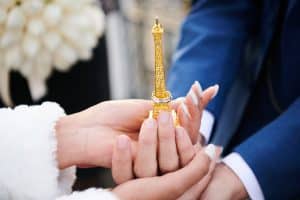
During a wedding in Paris, we organized a ceremony in a private garden with a breathtaking view of the Eiffel Tower. The couple chose a mix of modern vows and elegant Parisian details — a perfect blend of
sophistication and emotion.

Wedding planner Virginie MENTION, CEREMONIZE
How traditions have evolved into modern weddings
Modern weddings are a subtle balance between ancient traditions and personal creativity. Media, cinema, and destination weddings have spread rituals across cultures and continents, allowing couples to reinterpret customs in new ways.
Today, a wedding can take many forms: colorful dresses instead of white, outdoor ceremonies, beach weddings, or elegant celebrations in historic châteaux. Couples increasingly personalize their day with symbolic gestures that reflect their story — lighting a unity candle, planting a tree, or creating their own vows.
Some traditions have faded, while others have evolved to match modern values. The dowry, for instance, is now rare in Western cultures, replaced by a more egalitarian vision of marriage. Yet the spirit of connection, unity, and love remains unchanged.
For another wedding in Paris, we planned a ceremony at a classic Haussmann-style venue, blending timeless elegance with touches of contemporary art creating a deeply personal atmosphere.
Modern weddings also reflect new trends: eco-conscious celebrations, multicultural unions, or creative experiences where guests become part of the story through music, food, and shared rituals.
Why understanding wedding traditions matters today
Knowing where wedding traditions come from allows couples to give deeper meaning to their ceremony. It encourages them to choose rituals with intention not simply for aesthetics, but for what they represent emotionally and culturally.
Whether you dream of a classic celebration or a destination wedding, understanding the roots of these customs helps you personalize every detail: from the choice of dress to the arrangement of guests, and from the vows you exchange to the symbols you choose to include.
We believe that every wedding should combine timeless traditions with personal touches. It is this delicate balance that creates genuine emotion and unforgettable memories not only for the couple, but for everyone present.

Wedding planner : Virginie MENTION, CEREMONIZE
Conclusion
Marriage is a fascinating blend of ancient traditions and modern practices. From ancient rituals to contemporary weddings, each custom tells a story and enriches the experience of the couple and their guests.
By understanding the history of weddings, couples can create a ceremony that is more meaningful, authentic, and personal. We help couples combine tradition and originality to craft weddings that will be remembered for a lifetime.